

In DeFi lending platforms like AAVE and Compound, risk is centrally managed. In other words, everyone’s funds are pooled, and a single committee decides which assets are acceptable and how they’re managed.
By contrast, Morpho provides the lending infrastructure, but curators decide which assets to accept as collateral and how to deploy capital across markets. This separation enables curators to build different products with varying risk profiles. It also enables more products and use-cases to be built, letting curators innovate without being constrained by protocol-level governance.
At Avantgarde, curation is about managing risk deliberately, not chasing yield.
Morpho is a DeFi protocol that separates lending infrastructure from risk management. Morpho provides the rails and lets specialized managers, colloquially known as curators, decide how capital is deployed.
Each Morpho market is simple and immutable:
Once a market is deployed, these parameters cannot be changed.
Vaults operate on top of these markets as funnels of liquidity. Curators, through a number of preset roles on those vaults, determine:
In short: Morpho provides the infrastructure, curators can create markets and vaults.
Vaults enable a vast number of strategies across the risk spectrum. Some curators choose to target a level of yield and let risk vary. Others anchor their allocation around the utilisation rates at the market level. This can mean sometimes they are forced to go up the risk curve to achieve their target yield.
Our approach instead focuses on risk profile per strategy throughout yield environments.
Within the Morpho ecosystem, we believe liquidity is an overlooked risk metric.
In our V1 vaults, we design our withdraw queue so that:
Across our vaults we constrain adding to markets where available liquidity is not sufficiently high relative to position sizes.
This ensures:
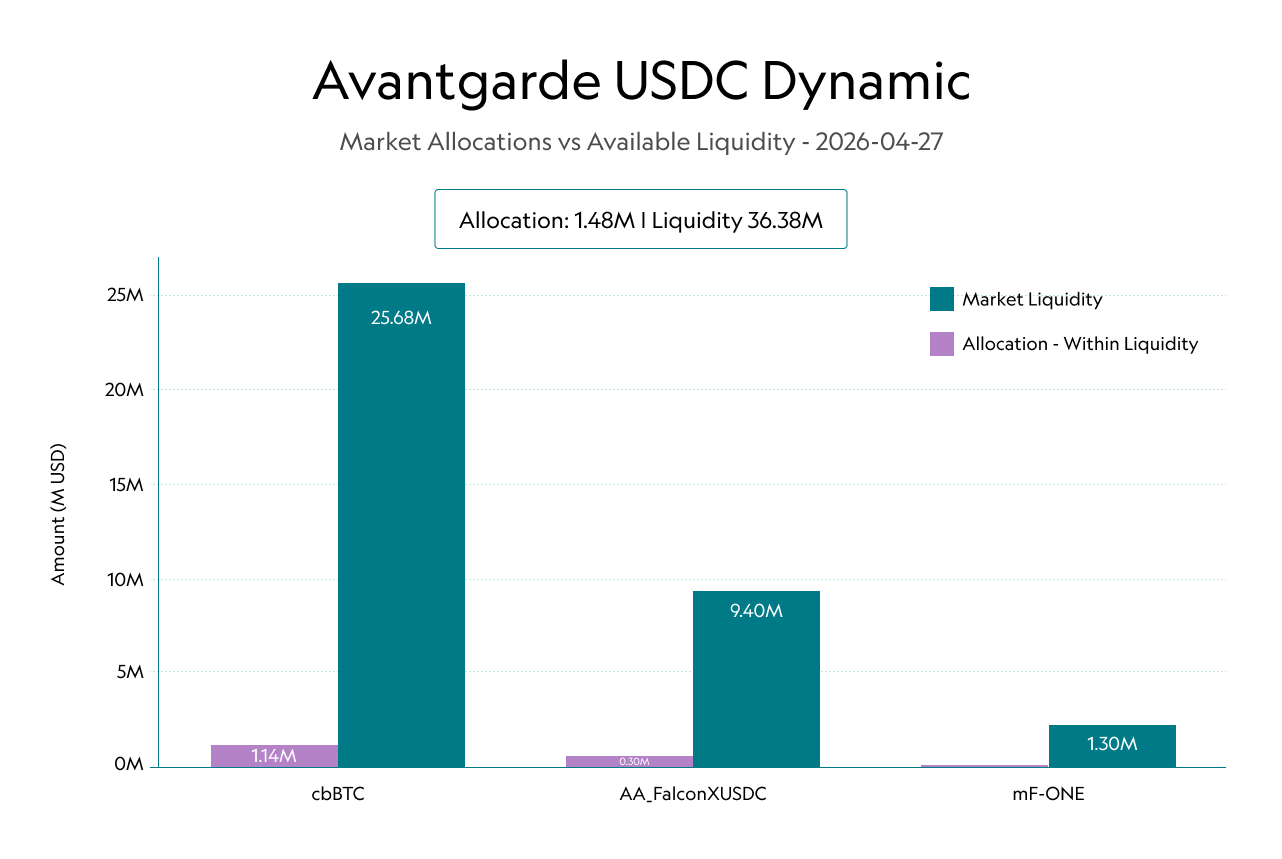
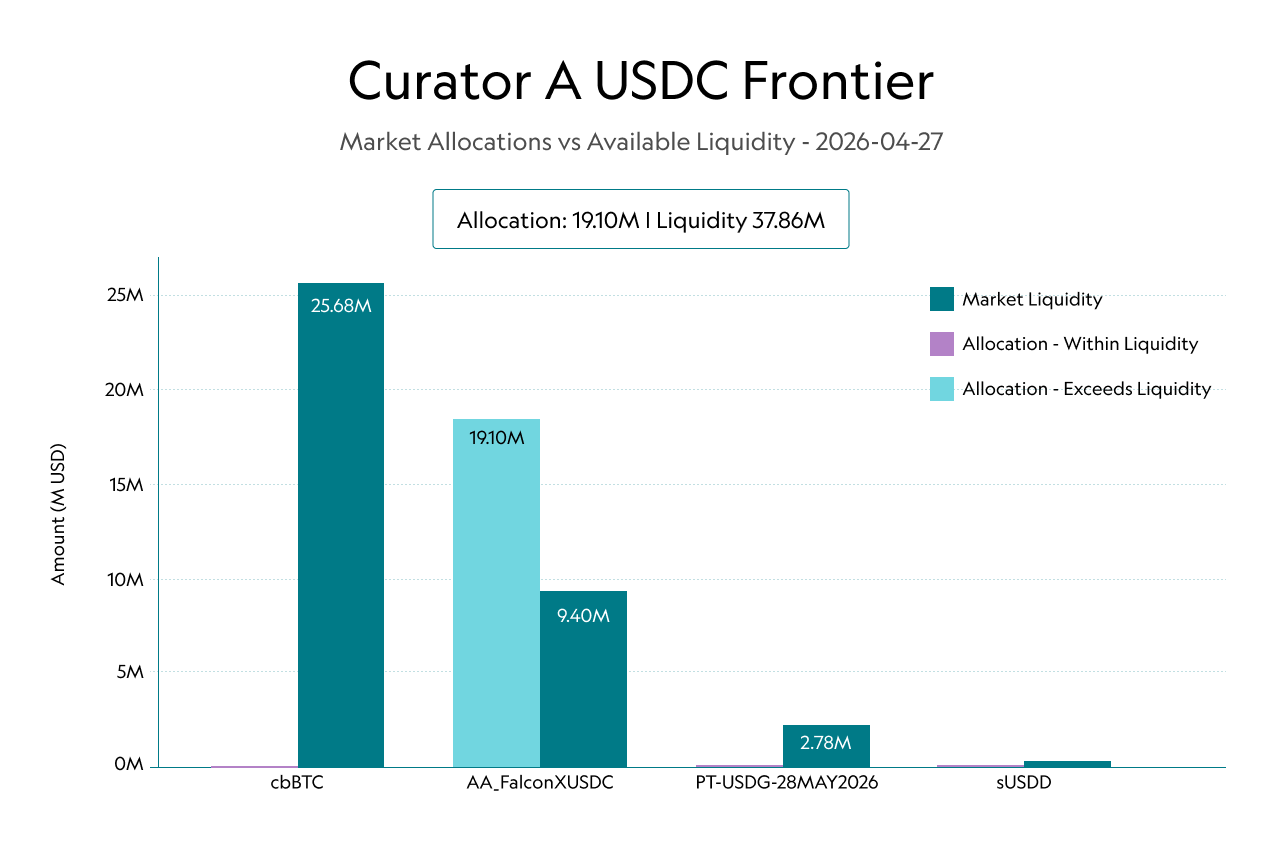
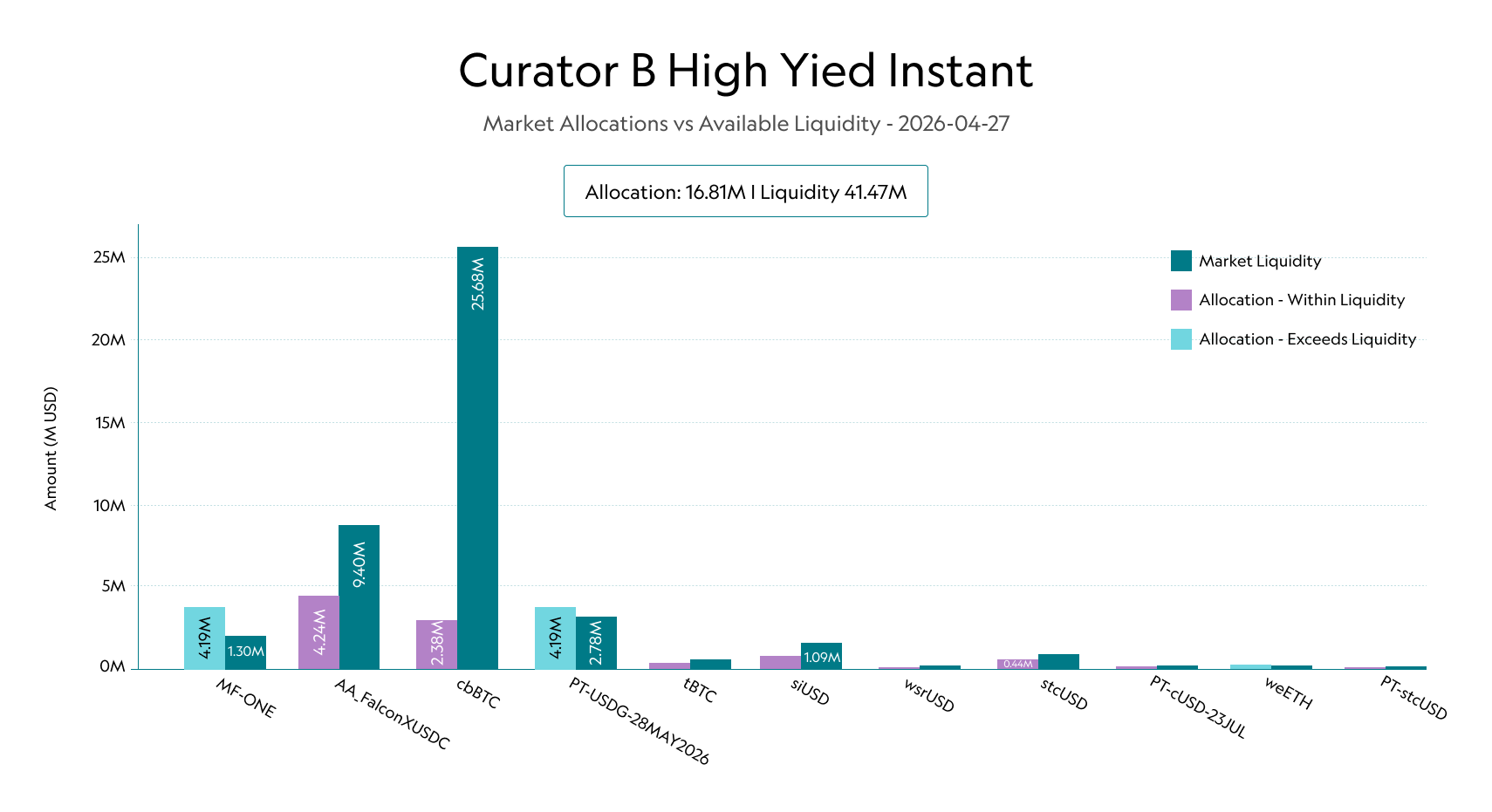
Markets that are eligible from a liquidity perspective are then screened for their yield relative to the lowest risk markets on Morpho Markets V1. Depending on the risk profile of a market, an Avantgarde vault will require a certain premium above that hurdle rate for an allocation to a market, ensuring depositors are being compensated for taking on additional risk.
Though Morpho has a comprehensive API, we focus on building rapid alerting using on-chain calls directly to ensure accuracy and reduce dependencies. We use multiple layers of alerts across a number of proprietary indicators in our in-house monitoring systems, to ensure new information is rapidly available to the team. Critical alerts then feed directly into our automated risk management where indicators point to immediate action at the vault level...
Though DeFi has come a long way during Avantgarde’s storied history, we are still ultimately operating in a space that is at the frontier of financial innovation. And whilst we can implement multiple layers of risk management and continue to refine our methodologies, there are always potential challenges to overcome within the DeFi ecosystem.
The Elixir/Stream crisis (November 2025), occurred during our operational tenure as Morpho curators and serve as lived experience of our ability to mitigate risk, and our decision making under uncertainty with an incessant focus on protecting depositors.
Stream; a synthetic dollar backed largely by a single counterparty collapsed 98%.
Elixir had made a large loan to Stream which made it an indirect counterparty to the loss.
Many curators had large exposure to Stream’s xUSD:
Many curators had large exposure to Elixir’s sdeUDS across a number of protocols:
With the recovery between Elixir and Stream unknown, vault curators with such positions were facing a couple of problems:
Engineering a Side Pocket to Protect Capital
After establishing a war room and speaking to the Morpho team, we first took a number of measures to contain the vault, including shutting the supply queue to disable any deposits. An additional consideration was that our vault was a v1.1 smart contract, which restricted the option to apply a haircut across depositors to mitigate the mispricing risk. Having gamed through the possible scenarios, which were highly uncertain, we came up with a novel solution to protect depositors:
A byproduct of this approach was that the AVGUSDCCORE vault was effectively converted into a side pocket for the distressed position. Though this was not a preferred path, the inability to adjust the pricing for the distressed position and the fact that we were already in the process of migrating to Morpho V2 vaults further supported our decision.
In order to also protect the tiny 0.5% small, unidentified depositors, we decided to leave our fee shares and sufficient liquidity in the vault to enable them to withdraw, which they eventually did.
Avantgarde was able to identify the risk exposure quickly and engineer its own solution due to its unique positioning.
As expected, the recovery for this position is being handled off-chain.
On March 22, 2026, Resolv Labs suffered a supply chain attack that escalated from a compromised contractor GitHub credential to control over its USR minting key. With insufficient on-chain safeguards, the attacker was able to deposit a negligible collateral and minted 80M unbacked USR.
The fallout hit Morpho markets hard. USR collateral continued to be priced at $1 via hardcoded oracles even as it collapsed on DEXs, allowing traders to borrow against devalued assets at full value. This drove utilization spikes and triggered automated allocators to add liquidity into distressed markets, amplifying losses across ~15 vaults.
Our vault had zero exposure to the Resolv exploit thanks to multiple defense layers built into our risk framework. First, our oracle classification system (4-tier: Safe → Hardcoded) flagged both wstUSR and RLP as the worst tier, where the feeds are owned and updated exclusively by the Resolv team, with no independent price discovery or no deviation threshold. Second, our Proof of Reserve methodology goes beyond on-chain checks. wstUSR's on-chain wrapping ratios looked healthy throughout the exploit, but couldn't detect the 80M unbacked USR diluting the real backing. Our framework requires independent off-chain verification of reserves alongside on-chain data and since that independent view wasn't available to us for Resolv, we were never comfortable allocating to these markets.
All changes on Morpho that perceivably increase risk require a timelock, allowing depositors a chance to redeem if they’re unhappy with incoming changes.
At Avantgarde, we take non-custodiality very seriously. As part of our current research & development we are always working on ways to minimize trust with respect to our ability to do anything a depositor does not pre-agree to.
Morpho Vaults V2 introduces:
Avantgarde has fully adopted Vaults V2 within our risk and automation infrastructure, and we look forward to the additional nuance and flexibility that Morpho enables for curators going forward.
Morpho’s modularity turns risk management into a competitive edge.
Avantgarde’s approach is simple:
Whilst we all like yield, we aim to manage risk and preserve capital first and foremost.